
Search Lee County Court Records Online
The main online path for Lee County court records is the South Carolina Judicial Branch Case Records Search, which links to the Lee County Public Index. Lee County is listed by the South Carolina Judicial Branch as Judicial Circuit 3 and county number 31. The Public Index is the official public search route for many Circuit Court records, including Common Pleas civil matters and General Sessions criminal matters that are available for public viewing.
The state court site warns that public case searching needs cookies and JavaScript enabled, and some case detail may require a pop-up exception. That matters in Lee County because a blank or blocked screen does not always mean no court record exists. The Clerk of Court page also says Lee County is e-filing, so the public portal and court rosters are central to modern case review, but the public view should not be treated as a promise that every document image is online.
- Identify the record type before searching. Common Pleas civil and General Sessions criminal files usually start with Circuit Court, while small claims and traffic often start with Magistrate Court.
- Open the state case records search and choose Lee County, or use the direct Lee County Public Index link.
- Search by exact case number when known. If the case number is unknown, search by party name and narrow by date or court type when the portal allows it.
- Use the roster link for hearing dates, motion calendars, trial terms, and other schedule questions.
- Contact the office that owns the file if the portal is incomplete, restricted, older, or not the right court level.
The South Carolina Freedom of Information Act is one public-access source shown in the research file for Lee County court records and public records. The statute is a useful starting point for open records, but court records also follow court rules, judicial access limits, redaction duties, and sealed-record orders.
The manifest image for this topic comes from the official South Carolina Code page for FOIA.
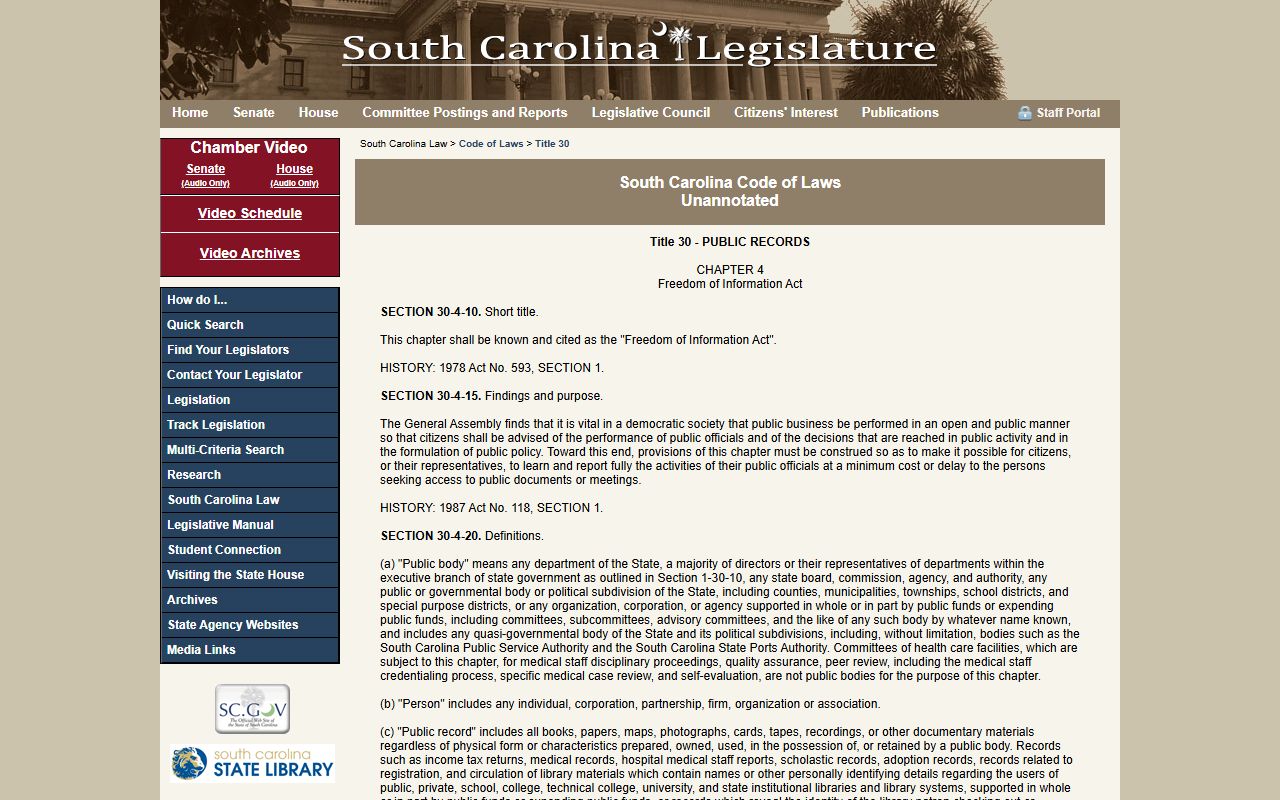
That source supports the public-records framework, but it does not replace the Lee County Public Index or the Clerk of Court for case-level records.
Lee County Court Records Search Fields
The research file captured the Public Index route but could not fully render the live Lee County portal in text. The field list below preserves that limitation and uses the state public-index structure documented during research. Searchers should confirm the current screen in a browser if a label appears in a different order.
| Field Label | Type | Required | Notes / Format |
|---|---|---|---|
| County | Implied URL path | Yes | Lee County is selected by the direct Public Index URL and county number 31. |
| Court Agency / Court Type | Dropdown or tab | Unspecified | May separate Common Pleas, General Sessions, Magistrate, or Municipal records where available. |
| Case Number | Text | No | Use the exact South Carolina case number if known. |
| Last Name | Text | No | Common name-search field for person parties. |
| First Name | Text | No | Narrows a person search when last name alone is too broad. |
| Business Name | Text | No | Used for civil cases with entity parties. |
| Date Range / Filing Date | Date fields | No | May narrow older and recent filings; exact labels were not rendered during research. |
| Search / Reset | Buttons | Not applicable | Starts the search or clears the criteria if the button is exposed. |
Types of Lee County Court Records
Lee County court records are not held in one flat database. The Clerk of Court is the local records officer for Common Pleas, General Sessions, and Family Court. Probate Court handles estates, marriage licenses, guardianships, conservatorships, and commitments. Magistrate Court handles traffic court, small claims up to the stated local threshold, warrants, and miscellaneous criminal matters such as wildlife, hunting, boating, and fishing violations.
For court-rule context, the official SC Judicial Branch Rule 610 Requests page explains judicial-record request limits, including bulk and compiled data. That source is important for Lee County court records because an individual case lookup is different from asking the Judicial Branch for a compiled report.
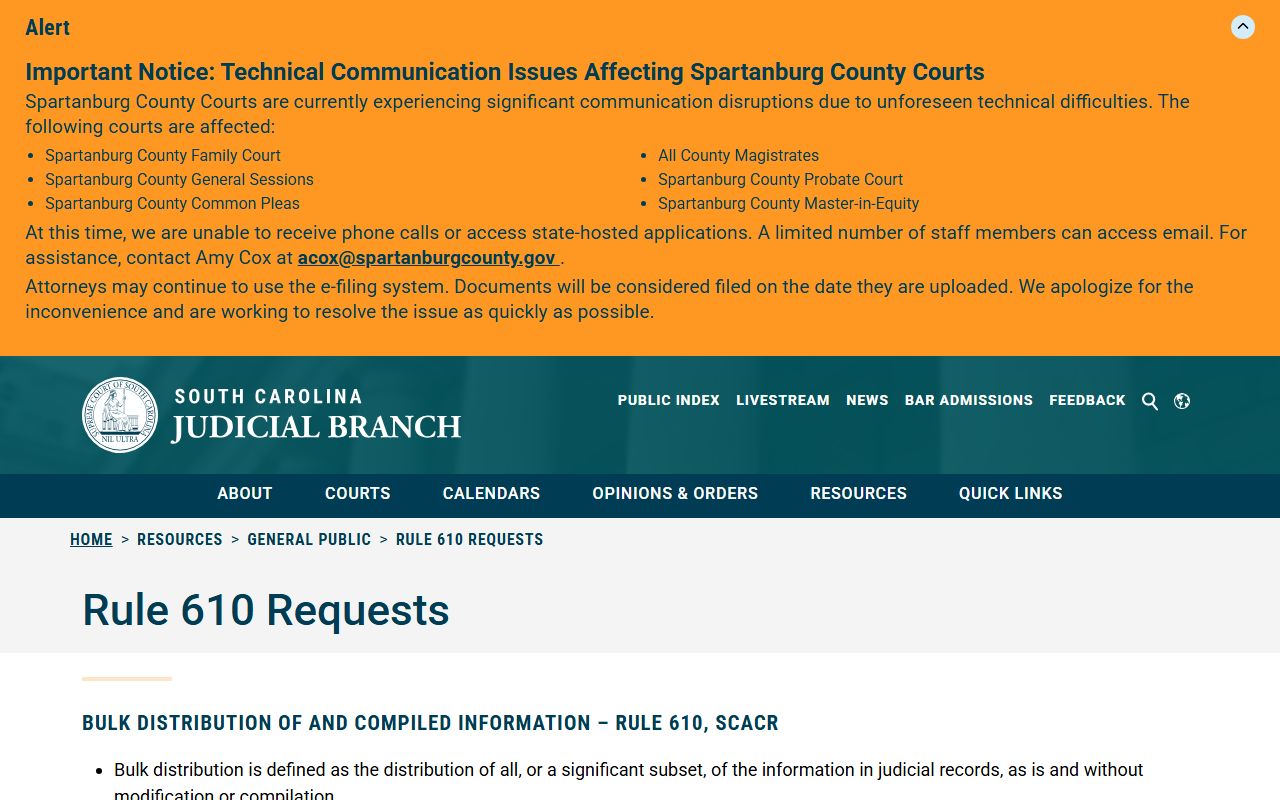
Rule 610 helps explain why the official record path may be direct case search or clerk contact, not a mass public-data download.
- Common Pleas civil files: complaints, answers, motions, orders, judgments, executions, and civil roster entries.
- General Sessions criminal files: criminal warrants once filed, bond paperwork, motions, plea documents, sentencing sheets, and disposition entries.
- Family Court records: divorce, custody, support, protective order, and juvenile-related files, with many access limits.
- Probate Court records: estate, will, fiduciary, guardianship, conservatorship, marriage-license, trust, and commitment matters.
- Magistrate Court records: small claims, traffic citations, lower-level criminal cases, warrant activity, payment records, and hearing schedules.
What Lee County Court Records Show
A Lee County court record usually shows the procedural history of a case, not just one result. The file may include party names, counsel, court level, filing date, hearing events, docket entries, charge or claim details, judgment, disposition, sentence, payment status, or appeal notices. The exact fields depend on whether the case is civil, criminal, family, probate, traffic, or Magistrate Court.
| Field | What It Shows |
|---|---|
| Case Number | The official case identifier used by the court and the Public Index. |
| Court | The venue, such as Common Pleas, General Sessions, Family Court, Magistrate Court, Probate Court, Municipal Court, or appellate court. |
| Parties | Plaintiff and defendant, State and defendant, petitioner and respondent, or estate and party names depending on case type. |
| Filing Date | The date a complaint, indictment, petition, citation, or other opening paper was filed. |
| Docket Entries | A chronological list of filings, hearings, orders, motions, continuances, judgments, pleas, or sentencing events. |
| Disposition | The outcome, such as closed, dismissed, guilty, nolle prossed, transferred, or judgment entered. |
| Documents | Listed filings or event descriptions; downloadable images may vary and should not be assumed. |
Public Access for Lee County Court Records
South Carolina public access is broad, but Lee County court records still have limits. FOIA defines public records broadly and requires public inspection and copying subject to procedures and exemptions. Court-specific access also uses Rule 610 for judicial records and South Carolina Rule 41.2 for redaction of personal identifying information in filings.
Rule 41.2 is especially practical for court users. It explains why Social Security numbers, financial account identifiers, medical details, victim information, employment history, proprietary data, and other sensitive material may be absent from a public filing. A missing detail may be a redaction, a sealed document, a nonpublic filing, or a field the public portal does not display.
The manifest image for the redaction rule comes from the official SC Judicial Branch Rule 41.2 page.
That rule is why a public Lee County court record can be valid while still hiding sensitive identifiers or protected facts.
Note: Lee County court record access depends on the filing office, the case type, and any court order limiting public view.
Restricted Lee County Court Records
Not every Lee County court record is public. Juvenile records are confidential under South Carolina law except for limited access by counsel, court order, and specific statutory exceptions. Adoption records, mental-health commitment files, sealed warrants, expunged criminal matters, victim-sensitive material, and some domestic or family details may be withheld or heavily redacted.
Expungement is not a clerk-only web update. For qualifying criminal matters in Lee County, the research routes expungement administration through the Third Judicial Circuit Solicitor. SLED CJIS says that after it receives an Order for Destruction of Arrest Records, users should allow four weeks for charge removal and should not expect a confirmation letter due to volume.
Lee County Court Records Access Channels
The strongest search path uses the office that owns the record. Civil Common Pleas and General Sessions files route to the Clerk of Court. Court calendars and docket rosters use the court rosters portal. Traffic, small claims, miscellaneous criminal, and warrant desk questions route to Magistrate Court. Estate and marriage-license matters route to Probate Court. State criminal-history reports route to SLED CATCH, not the Public Index.
For appellate matters, the assigned image comes from the SC Appellate Court Public Index page.
Appellate public access is separate from Lee County trial-court searching because appeals are handled at the state appellate level.
| Need | Best Channel | Lee County Detail |
|---|---|---|
| Case number, parties, status | Public Index | Use Lee County direct publicindex link. |
| Hearings and rosters | Court Rosters | Use the Lee County rosters portal before calling the clerk. |
| Civil case help | Clerk / Common Pleas | Cheryl Watkins is listed for Common Pleas in the staff directory. |
| Criminal case help | Clerk / General Sessions | Caroline Truesdale is listed as General Sessions/Court Coordinator. |
| Traffic or small claims | Magistrate Court | Use 803-484-6463 and the posted phone options. |
| Estate or marriage license | Probate Court | Appointments are required for Lee Probate Court. |
In-Person Lee County Record Requests
In-person access is the fallback when online Lee County court records do not show the whole file. The Clerk of Court office is in the Lee County Courthouse, and the staff directory places Clerk staff in Rooms 104, 106, and 107. The Lee County Clerk page says the office does not provide record checks, but it can provide a statement as to anything filed of record for $2.00. That statement is not the same as a statewide criminal background report.
Before visiting, check whether the file belongs to the courthouse, the Magistrate Court at 115 Gregg Street, the Probate Court, a state agency, or the Sumter-Lee Regional Detention Center. Probate appointments are required. Magistrate Court has a separate phone menu for traffic, civil claims, and warrants. County holidays can close counters even when an online state portal remains reachable.
Lee County Clerk of Court
Lee County Courthouse
123 S. Main Street
Bishopville, SC 29010
803-484-5341
PO Box 387, Bishopville, SC 29010-0387
Lee County Magistrate Court
115 Gregg Street
PO Box 2
Bishopville, SC 29010
803-484-6463
Monday-Friday, 9 a.m.-5 p.m., excluding county and state holidays