
Lee County Criminal Court Records
Lee County criminal court records are primarily General Sessions records for criminal cases handled through Circuit Court. South Carolina Circuit Court has a civil side called Common Pleas and a criminal side called General Sessions. The Lee County Clerk of Court page states that General Sessions houses criminal warrants, bond paperwork, motions, and sentencing sheets, and that the office works with the Solicitor, Public Defender, Probation, Pardon and Parole, South Carolina Department of Corrections, and other agencies.
That case file is different from a booking record. A person can be arrested and booked before a visible General Sessions case exists. A charge can begin as a warrant, citation, or booking charge and later be amended, reduced, dismissed, indicted differently, or resolved by plea or trial. The narrower arrest-to-charge path is handled through Lee County arrest records and court charges, while the criminal court record stays focused on the court file and its outcome.
The assigned criminal-history image comes from SLED CATCH, the state Citizens Access to Criminal Histories system.
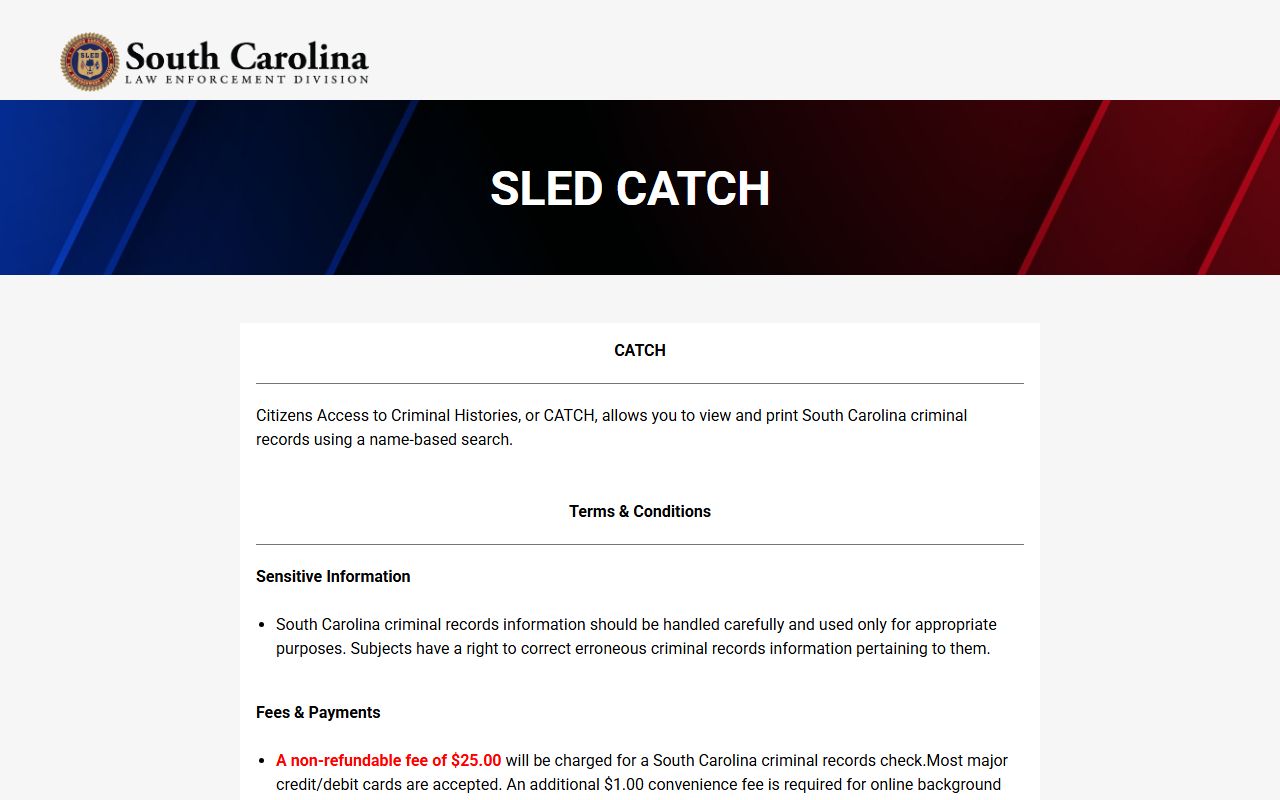
SLED CATCH is useful for statewide South Carolina criminal-history reports, but it is not the same record as a Lee County General Sessions case docket.
Search Lee County Criminal Court Records
The main case-file search route is the Lee County Public Index, reached through the South Carolina Judicial Branch Case Records Search. Search by exact case number when possible. If the case number is unknown, search by defendant name and narrow by court type or filing date when the portal exposes those fields. For hearing dates and terms, use the Lee County Court Rosters portal because rosters are the calendar layer.
- Confirm whether the case is General Sessions, Magistrate Court, Municipal Court, Family Court juvenile, or federal court.
- Open the Lee County Public Index and search by case number or defendant name.
- Review the docket entries for charge filings, bond events, motions, plea activity, disposition, and sentencing entries.
- Use Court Rosters for upcoming hearings, motion rosters, and term information rather than full case-file review.
- Contact the Clerk of Court when certified copies, older records, sealed-status questions, or missing docket entries require office review.
When the need is a background check rather than a court case, SLED CATCH is the statewide route. The research notes a $25 CATCH fee plus a $1 online convenience fee. CATCH searches are name-based, South Carolina-only, and can produce false positives or false negatives when names, dates of birth, aliases, or data submissions do not match.
Lee County Criminal Case Flow
A criminal court record grows as the case moves. Early entries may involve an arrest warrant, bond paperwork, or indictment. Later entries may show arraignment, motions, pretrial conferences, plea negotiations, trial settings, verdicts, nolle prosequi decisions, dismissals, sentencing sheets, restitution, fines, probation, or appeal notices. Not every case has each step, and a lower-court matter may remain in Magistrate Court rather than become a General Sessions case.
Case flow: Charges Filed › Arraignment › Pretrial / Motions › Plea or Trial › Disposition › Sentencing
| Stage | What Happens |
|---|---|
| Charges Filed | A warrant, citation, indictment, or solicitor filing starts the formal court accusation. |
| Arraignment | The defendant is advised of the charge and enters or preserves a plea depending on court procedure. |
| Pretrial / Motions | Attorneys file requests, argue evidence issues, seek continuances, or resolve bond and discovery disputes. |
| Plea or Trial | The case ends by plea, bench or jury trial, dismissal, transfer, or prosecutor decision not to proceed. |
| Disposition | The docket records the outcome, such as guilty, not guilty, dismissed, nolle prossed, or another final result. |
| Sentencing | The sentence can include jail, prison, probation, fines, costs, restitution, or other court conditions. |
What Lee County Criminal Records Show
A Lee County criminal court record should be read field by field. The charge label is only the accusation. The disposition tells what happened to that charge. The sentence tells what punishment followed a conviction. Bond paperwork may show release conditions but does not prove guilt. A warrant may be an original arrest warrant or a later bench warrant tied to failure to appear or violation of a court order.
| Field | What It Shows |
|---|---|
| Case Number | The South Carolina court identifier for the criminal case. |
| Defendant | The person charged, plus identifying information that may be limited or redacted. |
| Charges | The accusation or offense label filed by warrant, indictment, citation, or solicitor action. |
| Bond Paperwork | Release amount, conditions, surety, recognizance, or bond-related court action when filed. |
| Motions | Requests for court action, such as continuance, suppression, discovery, or other pretrial relief. |
| Plea | The defendant's response or negotiated case resolution where shown. |
| Disposition | The final or current outcome of the charge or case. |
| Sentence | The punishment after conviction, often supported by a sentencing sheet in General Sessions. |
Lee County Prosecutor and Defense
South Carolina calls the prosecutor the Solicitor. Lee County is in the Third Judicial Circuit with Clarendon, Lee, Sumter, and Williamsburg Counties. The research identifies Solicitor Ernest A. Finney III and the Third Judicial Circuit Solicitor page as the prosecution source for General Sessions and juvenile Family Court matters. The local Lee County contact listed in the research is 803-484-5341 ext. 381, and the staff directory also lists a Pre Trial Intervention contact at ext. 3176.
The official solicitor screenshot source is the Third Judicial Circuit Solicitor page.

The Solicitor source matters because prosecution decisions, diversion programs, victim services, and expungement administration do not all sit with the Clerk.
Public defender appointment is separate from prosecution. SCCID states that Public Defenders are appointed by the court to represent indigent defendants in criminal court. Lee County research lists Edgar R. Donnald Jr. as Circuit Public Defender, plus assistant public defender contacts. The Lee County Clerk page says a Public Defender application can be completed in the Clerk's office with a $40 application fee.
Lee County Charges vs Convictions
A charge is not a conviction. A charge can be amended, reduced, dismissed, nolle prossed, transferred, or resolved by trial. A conviction occurs only after a guilty plea, guilty verdict, or equivalent final disposition. Lee County criminal court records may show both charged counts and final outcomes, so readers should not stop at the first offense label in a docket.
| Point | Charge | Conviction |
|---|---|---|
| Meaning | An accusation filed through a warrant, citation, indictment, or solicitor action. | A final finding of guilt by plea, verdict, or equivalent disposition. |
| Record stage | Appears early and may change as the case moves. | Appears after final outcome and may lead to sentencing. |
| Proof | Based on accusation and legal filing standards. | Based on plea, verdict, or court judgment. |
| Lee County source | Public Index, Clerk, Magistrate, warrant, booking, or solicitor records. | Public Index disposition, sentencing sheet, Clerk copy, or SLED criminal history when reported. |
State Criminal History Limits
SLED CATCH is a separate state criminal-history product. It is not the Lee County court docket, it is not the jail roster, and it is not an active-warrant search. The research file states that CATCH is name-based, requires last name, first name, and date of birth, and may use a Social Security number if provided. It also notes that wanted persons are not included.
The criminal-history correction and expungement image comes from the SLED CJIS page.
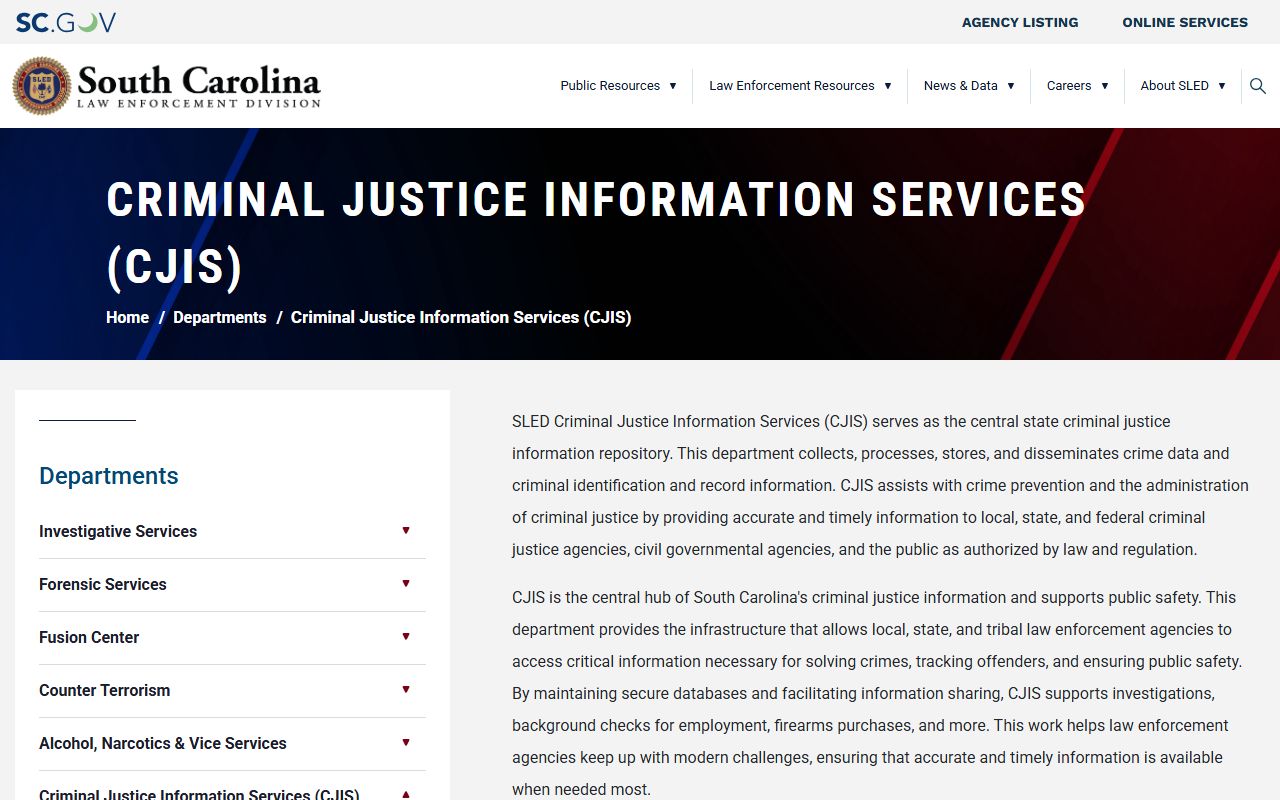
SLED CJIS is the better source for state criminal-history correction and post-expungement processing timing than the Lee County Public Index alone.
Lee County Sealed vs Expunged
Sealed and expunged records are different. A sealed record is hidden from public access by law or court order but may still exist for limited court or agency use. An expunged record has been removed or destroyed under an order for qualifying records, subject to statutory exceptions and limited retention rules. Lee County criminal expungement routing starts with eligibility and solicitor administration, not with a public website simply deleting a case.
| Point | Sealed | Expunged |
|---|---|---|
| Public visibility | Hidden from ordinary public view. | Removed from public criminal-history access after proper order and processing. |
| Record existence | May still exist under restricted access. | Destroyed or removed as ordered, with limited lawful retention possible. |
| Lee County route | Usually court order or law-based confidentiality. | Third Judicial Circuit Solicitor administration for qualifying criminal matters. |
| SLED role | Not the first route for court sealing. | Processes orders after receipt and asks users to allow four weeks for charge removal. |
Public Access to Lee County Criminal Records
Adult Lee County criminal court records are generally public after filing, but public access is not unlimited. South Carolina FOIA broadly supports access to public records while excluding records made confidential by law. Rule 610 applies to judicial records and compiled data limits. Rule 41.2 supports redaction of sensitive personal information in filings.
Juvenile court records have stronger confidentiality rules. The public defender statutory framework and juvenile confidentiality image comes from the official South Carolina Code Title 17 Chapter 3 page.
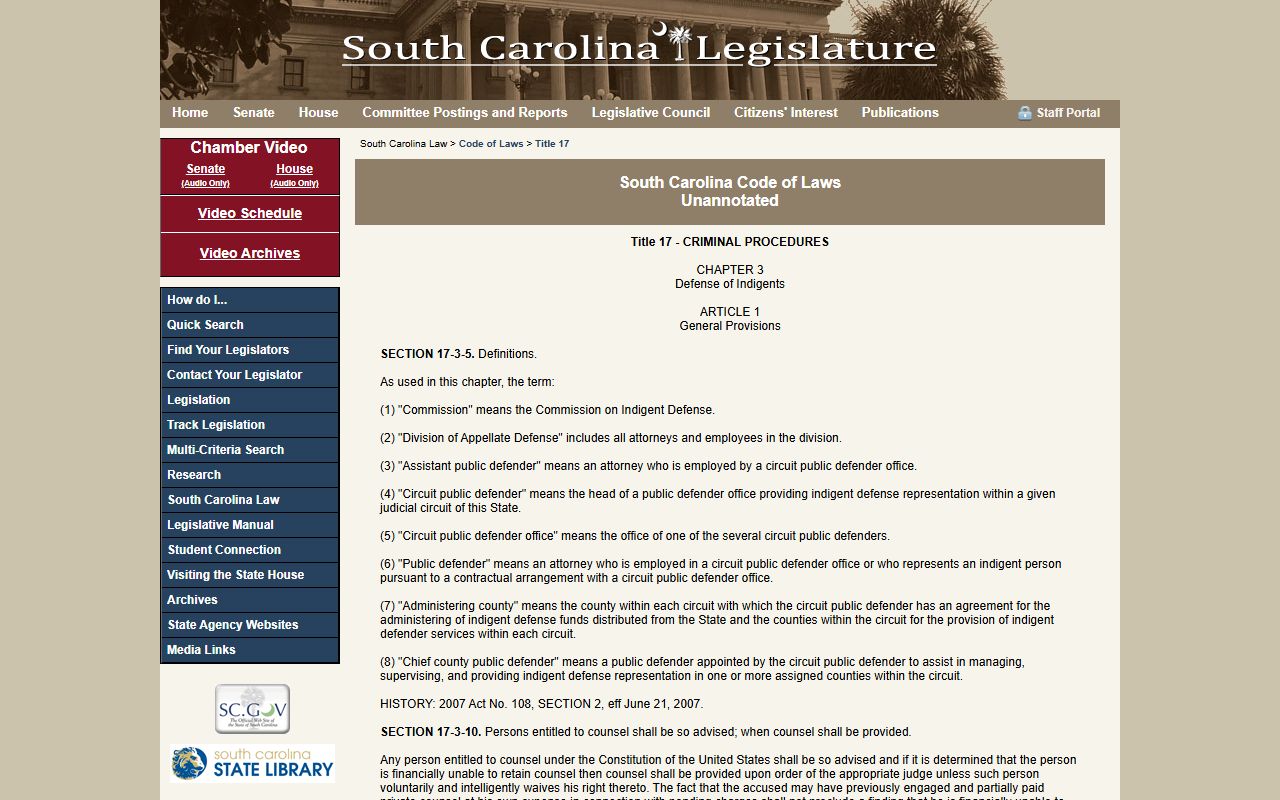
Indigent defense and public-access rules affect criminal cases in different ways, so representation status should not be confused with public visibility.
Note: Juvenile, sealed, expunged, victim-sensitive, and personal-identifier details may be absent from public Lee County criminal records.
Custody vs Court Disposition
Custody status is not the same as criminal court disposition. Sumter-Lee Regional Detention Center handles local and regional detention for people charged with felony or misdemeanor crimes, including pretrial and post-trial custody. SCDC handles sentenced state-prison custody. Federal custody uses the Bureau of Prisons. A person may be in jail before the court file shows final charges, and a person may have a court disposition after leaving local custody.
The statewide solicitor listing image comes from the South Carolina Commission on Prosecution Coordination circuit solicitors page.
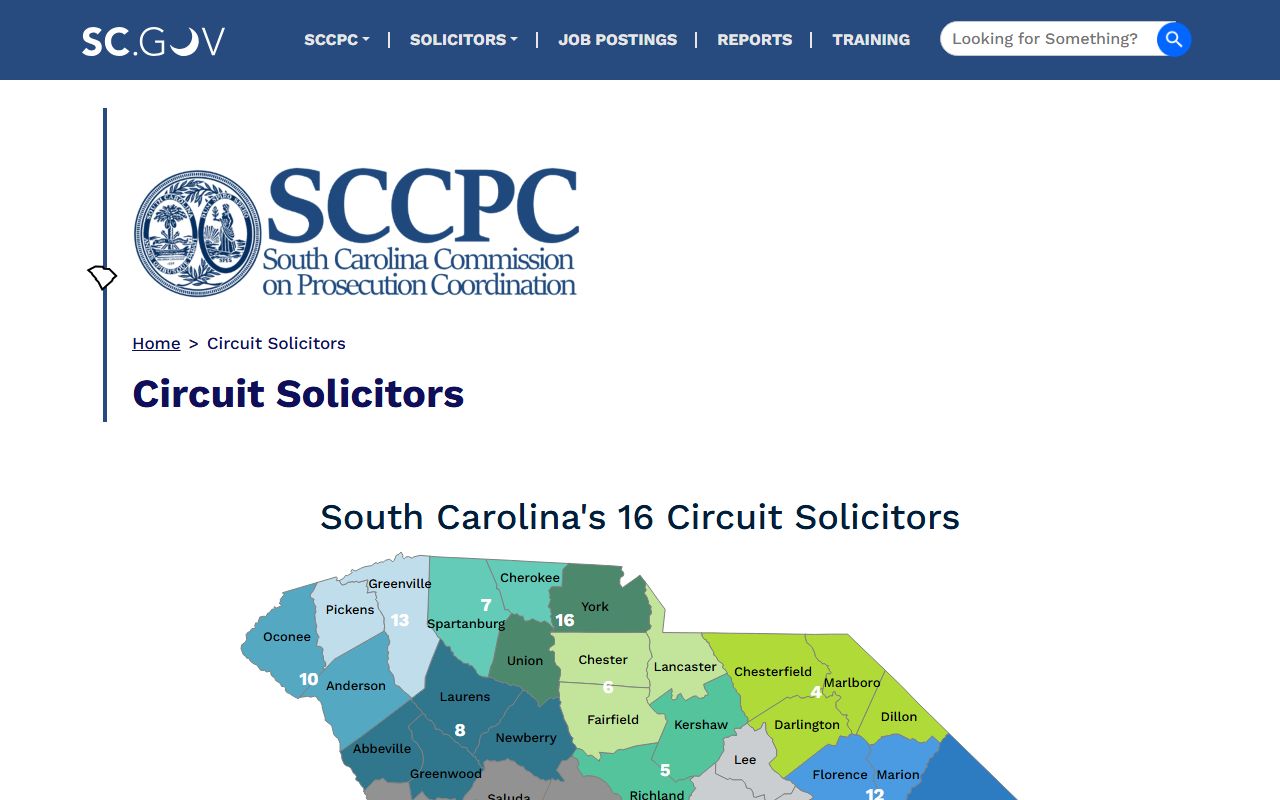
That statewide solicitor source reinforces that Lee County criminal prosecutions are part of the Third Judicial Circuit, not a stand-alone county prosecutor system.